

Perception is
defined as the process of assigning meaning to information received about the
environment based on past experience.
Perceptual laws was developed
by German psychologists; the Gestalt laws describe how we interpret the complex
world around us.
- Few real-life examples of the Gestalt laws are - series of flashing lights appear to be moving, able to read a sentence like this, notli ket his ort hat (not like this or that)
According to
Gestalt psychology, this apparent movement happens because our minds fill in
missing information.
Motion pictures
are based on this principle, with a series of still images appearing in rapid
succession to form a seamless visual experience.
Gestalt psychology
focuses on how our minds organize and interpret visual data. It emphasizes that
the whole of anything is greater than its parts.
Based upon this
belief, Wertheimer along with Gestalt psychologists Wolfgang Köhler and Kurt
Koffka, developed a set of rules to explain how we group smaller objects to
form larger ones (perceptual organization). They called these rules the Gestalt
Laws.
What is
Perceptual Organization?
Perceptual
selectivity is concerned with internal and external variables that gave
individual’s attention.
Perceptual
organization is concerned with process of organizing the inputs into
identifiable whole objects.
A person’s
perceptual process organizes the incoming information into meaningful whole.
Principles of
Perceptual Organization
1. Figure Ground
Figure-ground
perception is the ability to differentiate an object from its background.
Figure–ground
organization is a type of perceptual grouping that is a vital necessity for
recognizing objects through vision.
In Gestalt
psychology it is known as identifying a figure from the background. For
example, black words on a printed paper are seen as the "figure", and
the white sheet as the "background"
2. Perceptual
Grouping
There is a
tendency to group several stimuli together into a recognizable pattern.
Grouping is done on the basis of Closure, Continuity, proximity or similarity.
Laws Of
Perceptual Organization:
Laws of perceptual organization is based
on External and Internal Factors of Perception.
External Factors
of Perception
- Laws of Proximity
- Laws of Similarity
- Laws of Continuity
- Laws of Closure
- Laws of Contrast
Internal
Factors of Perception
- Past Experience
- Attitude or Mind Set
The Law of Proximity:
Stimulus elements which are closer tend to be perceived as one entity. It will be observed that the closer elements in figure below can be perceived as groups forming vertical columns.


The Law of Similarity:
Similar elements of a stimulus tend to be part of a unit. This
similarity may be in grey level, colour, orientation or shape which is
perceived as horizontal columns.

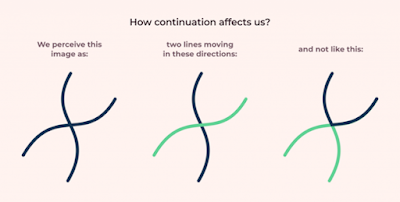
The Law of Continuity:
Stimuli tend to form a group which minimizes a change or discontinuity,
which is perceived as two lines with first order continuity.
The Law of Closure:
Stimulus elements tend to be grouped into a commonly known complete
figure. It will be perceived as a circle despite the fact that some part
of it is missing.

Law of Contrast:
Contrast effect is an unconscious bias that happens when two things are
judged in comparison to one another, instead of being assessed individually. The blue circle appear smaller and bigger in contrast of the black circles.

Law Of Past Experience:
The perception of visual elements
is affected by someone’s past experiences.
Most would say the image above
depicts a house rather than a square, rectangle, and triangle. This is an
instance of the brain perceiving a picture based on familiarity rather than
seeing random shapes.

Unlike the other gestalt principles, the past experiences principle is highly subjective and based on the individual since people have different experiences.
Attitude or Mental Set:
Another important mental condition that determines our
perception is attitude or mental set. A thirsty man sees at a distance a vague
figure as a pot of water.
Kirthi's Exam Insight:
"In the B.Ed exams, the Laws of Perceptual Organization are essential for understanding how students process information. To score a perfect 10/10, you must include the core Gestalt phrase: 'The whole is greater than the sum of its parts.'
Presentation Tip: Never write this answer without diagrams. For every law (Proximity, Similarity, Closure, etc.), draw the simple dot or shape patterns provided in these notes. Highlighting that perception is shaped by 'Past Experience' and 'Mental Set' shows the examiner you understand the subjective nature of learning, which is the key to securing the highest marks!"




0 Comments